

If there is one artistic medium that represents the patience, tolerance, and deep soul of the Vietnamese people, it is undoubtedly Lacquerware (Sơn mài). Far beyond a mere craft, Vietnamese lacquer is a feat of time, a process where humble droplets of tree resin transform into brilliant masterpieces under the gifted hands of artisans.
Unique Characteristics: When "Sanding" Creates Magic
Lacquerware is found in many Asian countries like Japan and China, but Vietnamese lacquer possesses one-of-a-kind characteristics. The most significant difference lies in the "Mài" (Sanding/Grinding) technique.
 What sets Vietnamese lacquer apart from the rest of the world is its unique grinding technique.
In other countries, artisans often focus on applying lacquer to achieve a glossy, smooth finish from the start. However, in Vietnam, the beauty of lacquer is hidden beneath dozens of stacked layers of resin. The artist must use whetstones and sand with water to gradually reveal the layers of color, eggshells, and gold or silver leaf buried deep within. It is a "reverse" process: the more you sand, the clearer the painting becomes; the more you sand, the more the surface shimmers.
The palette of Vietnamese lacquer is also highly distinctive, with four basic tones: black, red (like cockroach wing), gold, and silver. The combination of natural materials such as eggshells and mother-of-pearl against a deep, somber lacquer background creates an artistic space with profound depth, where light does not merely reflect off the surface but radiates from within the work itself.
Evolution in the Contemporary Flow
Today, lacquerware is no longer confined to traditional jewelry boxes or classical landscape paintings. The craft is undergoing a powerful revolution to harmonize with the breath of the modern era.
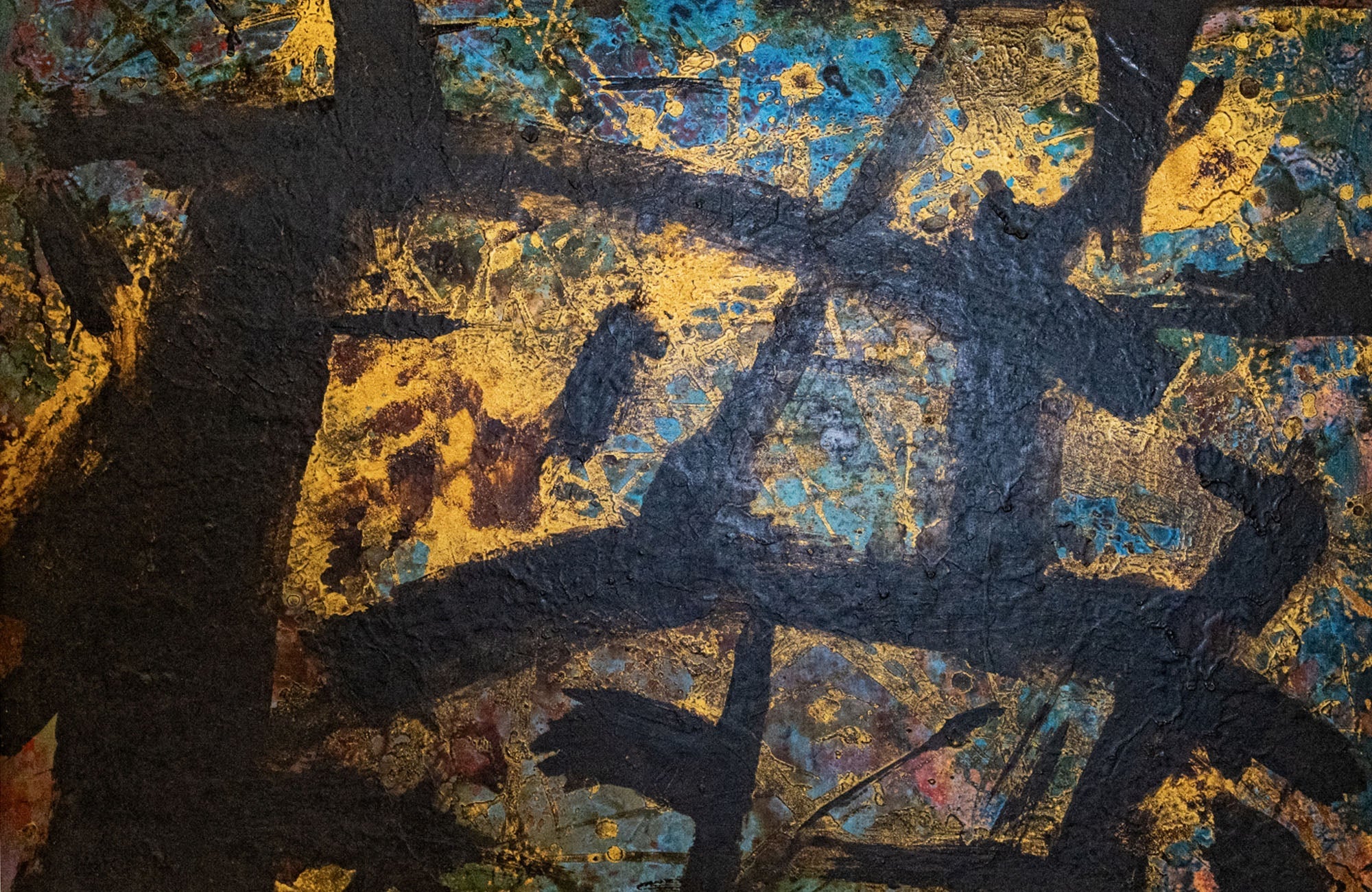
 A lacquer painting by artist Nguyen Tu
Young artists and dedicated craftsmen have introduced lacquer into new realms: from high-end interior design and fashion accessories to abstract sculptures. Angular geometric shapes and unconventional colors expressed through traditional materials create a captivating contrast, bringing a fresh perspective to international art enthusiasts.
Continuity of Tradition
The most precious aspect of the lacquer craft today is its continuity. Lacquer art is inherently rigorous, demanding that the craftsman possess a quiet soul and absolute loyalty to the material. A lacquer painting or a lacquer-on-ceramic vase can take months, or even an entire year, to complete.
This continuity is not just about teaching techniques; it is about passing down the "heart" for the craft. When future generations watch their ancestors patiently sand each layer of resin, they learn more than just a trade, they learn how to cherish national identity and find the courage to reinvent themselves upon a traditional foundation.
Vietnamese Lacquerware, therefore, has never been a forgotten heritage. It is a living entity, constantly moving and reinventing itself. When contemporary artists dare to move past old glories to forge ahead, they are writing a new chapter for a proud cultural flow of the nation.

